
The Creation of Experience, The Basic Model®, A Contribution to The Operating Manual for the Self
INTRODUCTION
The past series of Letters dealt with pain and suffering and effective strategies for avoiding them. Pain comes from painful experiences. In this Letter we will discuss how experiences are created.
We will write a series of Letters about traps, vicious circles, and self-fulfilling prophecies. But before that it is necessary to explore some aspects of human functioning that we are calling the basic model. It explains much of what we do each moment of the day. When examined closely our activity appears complex yet it happens so rapidly that we don’t even notice.
As we will see we can understand and alter many aspects of the creation of experience. The only thing we cannot change is our immediate experience. It occurs in the present moment as a “fact” that already exists. It is something that we have already created by our actions and comes to us in the “now.” However, and most importantly, we can create new future experiences for ourself by working with the basic model.
Point of Empowerment: Living life is experiencing. While we cannot change our immediate experience of the present moment we can work with aspects of the basic model to change our future experiences. How do we do this? We understand how the model works and put our human abilities to work.
THE BASIC MODEL
Here is a chart of the basic model outlining its components and their order.
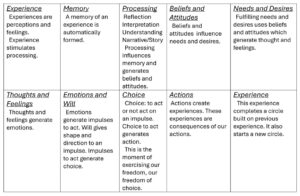
The basic model shows us the big picture of the how our consciousness flows from experience to experience. Let’s briefly look at each step to get a preliminary understanding of the process.
- Experiencing is simply our perceptions of seeing, hearing, touching, tasting, and smelling along with our feeling in the present moment, the “now.”
- A memory of each experience is automatically formed as part of our human functioning.
- Processing starts with reflecting–thinking about our experience to help us digest and assimilate it. We may learn from our experiences or deny and suppress/represses certain painful aspects of an experience. In denying and suppressing/repressing we cannot process or learn from the experience.
- Interpreting is the act of creating or perceiving meaning. Creating and perceiving meaning is a natural human function as we seek meaning in our life.
- Understanding seeks an explanation for our experience and facilitates learning.
- A narrative combines the elements of experience into a meaningful whole. A narrative is an objective description of events with complete detail.
- The story we create is a narrative but usually contains a “slant,” a certain point of view. Stories are usually distorted with embellishment and drama. They are often, “This is what happened to me,” told in victim mode. Victim says, “This is what happened, it was painful, and I was powerless to stop it.” Stories can add pain to memories. We can also tell stories of victory, triumph, overcoming challenge, or accomplishment.
Point of Empowerment: The results of processing–reflection, interpreting, understanding, narrative, and story influences a good portion of the memory of an experience.
- Beliefs and attitudes are natural aspects of the self that we use to guide ourselves toward fulfilling our needs and desires. Beliefs and attitudes are about our self, the world, and about our self in the world.
- Needs and desires are natural aspects of the self that provide motivation for action. They can arise automatically and spontaneously or we can create them deliberately.
- Thoughts and feelings usually pertain to specific situations and to specific needs and desires. They are often about our strategies to get what we need and want and about how to have new experiences that we seek.
- Emotions are a combinations of thoughts and feelings. They are impulses to act.
- Will helps to shape an impulse. For example, it can give strength and determination to an impulse or it can weaken and make an impulse ineffective. Will is generated by intension and purpose.
- Choice exists in the moment between an impulse to act and the action. Here is where freedom lies, our freedom of choice.
- An action is something we do. We move our body in a way that accomplishes something. The consequence of this action is a new experience.
- A new experience is created. It is always a new experience but can seem like repeating an old experience. This experience is often a result of how others have reacted to our actions. At other times it is the culmination of internal processes within ourself. In either case, a cycle is completed and a new cycle begins.
There are transitions from one aspect of the cycle to the next. The transitions are stimulates, precedes, follows, influences, generates, and creates. Stimulates triggers something that follows. Precedes is before and follows is after. Influence is part of causing. Generates and creates are causing.
Though we have outlined the basic model as consisting of one step after another, in practice we can skip ahead or go back to a previous step before moving ahead. The process is “not strictly linear, ” not a straight line. And of course it happens “in the twinkling of an eye,” extremely rapidly. But we can slow it down to examine how it operates within ourself.
Practice: Print a copy of the basic model. Carry it with you throughout the day. Identify what you are doing at each moment of the day by becoming aware of your activity and using the model to categorize that activity. This is a powerful exercise that will teach you a tremendous amount about yourself and how you work. In using this practice you are laying the groundwork for whatever degree of personal change and transformation you wish.
To gain a better understanding of this material read other Letters for Insight and Innovation on belief, freedom, and effective strategies for living. Here is the link to an index of these articles. https://iifsd.org/library/newsletters/
CONCLUSION
We have described a basic model to help us understand how we respond to and create experiences. Breaking this process down into steps shows us where to work with ourselves so that we may change in order to create new experiences. We now have tools to greatly influence the flow of our lives.
In future Letters we will apply the Basic Model to free ourselves from traps, vicious circles, and self-fulfilling prophecies.
Point of Empowerment: The basic model is one of the most powerful tools we have for living in the Age of Empowerment.