
Respect—A Clear and Useful Definition
INTRODUCTION
Everyone wants respect, to be respected. It makes us feel good about ourself. We often say or hear, “You don’t respect me.” This statement is accompanied by feelings of frustration, disappointment, hurt, and anger. A position of authority or an accomplishment can lead to demanding respect or feeling that we are automatically entitled to it. Sometimes we are intensely offended and indignant when we don’t get the respect we “deserve.” We feel that it is our “right” to be respected and to have the privileges that respect seems to bring.
Chronic disrespect in a relationship damages and degrades the relationship. It is often a source of very intense conflict. This conflict is often fueled by confusion about what respect is as each person has their own definition of respect. Since respect and respecting can be seen as very important and be the cause of much conflict it is important to have a clear and useful definition of what respect is and is not.
Respect and valuing are connected. We respect what we value and value what we respect. Disrespect can cause feeling devalued. Feeling devalued feels painful.
THE DEFINITION OF RESPECT
There is often much confusion about the definition of respect. A popular definition is that respect means to admire. Yet even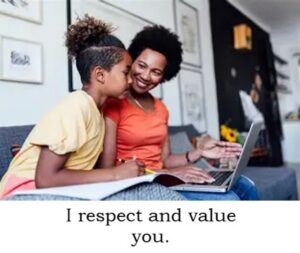 though admiration may or may not be present, respect can still happen. A distorted definition of respect is that it means to obey, to conform to another person’s wishes. “Respect me, and do what I tell you to do,” is often the demand.
These statements are not the definition of respect. If we break the word respect apart we get re and spect. Re means about. Spect means to see. Therefore respect has two parts. The first is to look and see. The second part is to see something about the person or thing that you are looking at. This is a simple yet useful and powerful definition. Respecting becomes a valuable activity not something that needs to cause conflict or insult.
Here are some examples of respecting. I look at my spouse and see someone that I love. I look at my colleague and see his or her strengths and weaknesses. I look at my boss and see his arrogant attitude. And since my boss is an important person in my life I look closely at him, I respect him, even though I may not like or admire him.
Point of Empowerment: We desperately want respect because we want to be known, to be seen for who we are. As we respect another person, we can know more about this person.
Point of Empowerment: Respect, looking and possibly noticing something of value, becomes an uplifting and important activity that can lead to the doorways of understanding and possibly the closeness of intimacy.
USES AND BENEFITS OF RESPECT
Practice: Become aware of who or what you respect and what you see as you look. Consider the question, do you value what you see?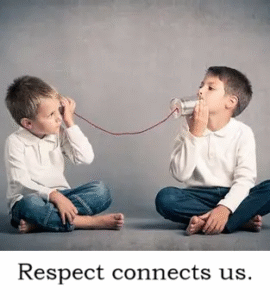
Looking at and seeing can stimulate further inquiry. Asking questions can lead to increased understanding. Consider these questions. Why are we looking at this particular person? What does she mean to us? What do we see when we look at this person? Do we like and admire him or do you dislike and think little of him? In looking at this person, what do we hope for or expect to see?
Point of Empowerment: There is a before respecting and an after respecting.
Respecting is an activity of paying attention. Since paying attention takes effort there is some reason why we decide to make the effort. This is the “before respecting,” the reason we make the effort. We choose what to respect. How do we make that choice? We must initially value what we respect. Are we curious? Is there interest? Or are we afraid of something and feel the need to take a closer look?
Examples of the after respecting:
- We can see a person’s uniqueness and that there is something special about that person worthy of our respect.
- We can have more understanding of the person/thing we respected.
- We may increase or diminish admiration, valuing, or love of the object of our respect.
- We can have additional understanding if we ask, “Why did I change my mind about this person or thing or idea that I used to value and deemed worthy of my respect but no longer have that respect?”
Practice: Notice when you look at something or someone with respect. What is about them that you consider worthy of respect? Why? Learn something new about yourself.
CLARITY OR DISTORTIONS OF SEEING
When we respect, how clearly do we see or how distorted is our vision? We seek the ability to be objective and not to be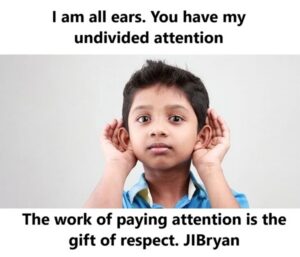 handicapped by our subjectivity. Our subjectivity is our vision completely determined by who we are, by our strengths and weaknesses.
There are many causes for a lack of objectivity. Some of these are strong feelings like anger, hate, or love; prejudices and stereotypes like “all Muslims hate Jews;” hidden agendas like fault finding to avoid intimacy or blind trust to prove that you cannot trust anyone. Another big distortion is caused by our emotional defenses, strategies we use when feelings or situations are overwhelmingly or unbearably intense and painful. The first defense we always use is denial, pretending that something does not exist even though it does. For example, my parents’ brutal criticism of me was “good parenting,” and an “expression of their love.” To use denial we have to be “deaf, dumb, and blind,” physically and emotionally. Blind means we do not see and therefore cannot respect. Denial prevents respecting.
Fear can cause us to be overly subjective in our perceptions and actions. If someone poses a threat to us we “respect” them because of the danger he or she represents. Will our fear cause us to misperceive what we are looking at, what we are respecting? Will we overestimate or underestimate a danger or threat and therefore not be objective.
Point of Empowerment: In order to perceive accurately we need objectivity—undistorted perception.
Practice: When looking at something, respecting, and you doubt your objectivity, ask yourself how another person might see it, a person whose opinion you respect.
SELF-RESPECT
Are you worthy of your own respect? Do you value yourself enough to make the effort to see who you are? Are you willing to see your strengths and weakness? Can you be objective when looking at yourself?
Practice: Take a good look at who you are. Respect yourself. Learn and understand something about yourself. Where do you value or devalue yourself?
There is a useful sequence of activities to use when engaging in self-respect. The first two steps are to recognize—to see and to describe what you are seeing. The third step is to acknowledge—to take ownership of what you see. The fourth step is to is to appreciate—to see the usefulness and goodness of what you see about yourself even if it feels negative. The fifth step is to value—to see how the usefulness and goodness of you enhances your life.
INQUIRY
To conduct an inquiry we closely examine a person or a thing with the goal of achieving increased respect and understanding of that person or thing. The ways of examining or “looking at and respecting” for the purpose of inquiry are to:
- Inspect: to look into or go beneath the surface, to investigate what is not immediately visible.
- Circumspect—to look around, to see a context or the big picture. For example, see the ethnicity or culture that a person belongs to.
- Perspect—to create a perspective which is a “point of view,” like the point of view of valuing or creating meaning for example.
- Retrospect—to look into the past to gain understanding and perspective.
- Expect—to look into the future, to see what you want for the future or to see what you think is coming into your present.
Point of Empowerment: Conducting an inquiry can create the kind of understanding that can move you forward toward accomplishing your goals and toward creating and experiencing the next highest version of yourself.
CONCLUSION
We defined respect and explored some ideas about it. The definition and these ideas can be extremely useful and even transformative if understood and put into practice. We passionately desire to be respected, which is to be seen and when this happens we feel known and loved. To be known and loved are needs that every human has. Understanding these needs allows us to see why we value respect so much.